
What if you could confidently navigate the world of Python programming with ease?
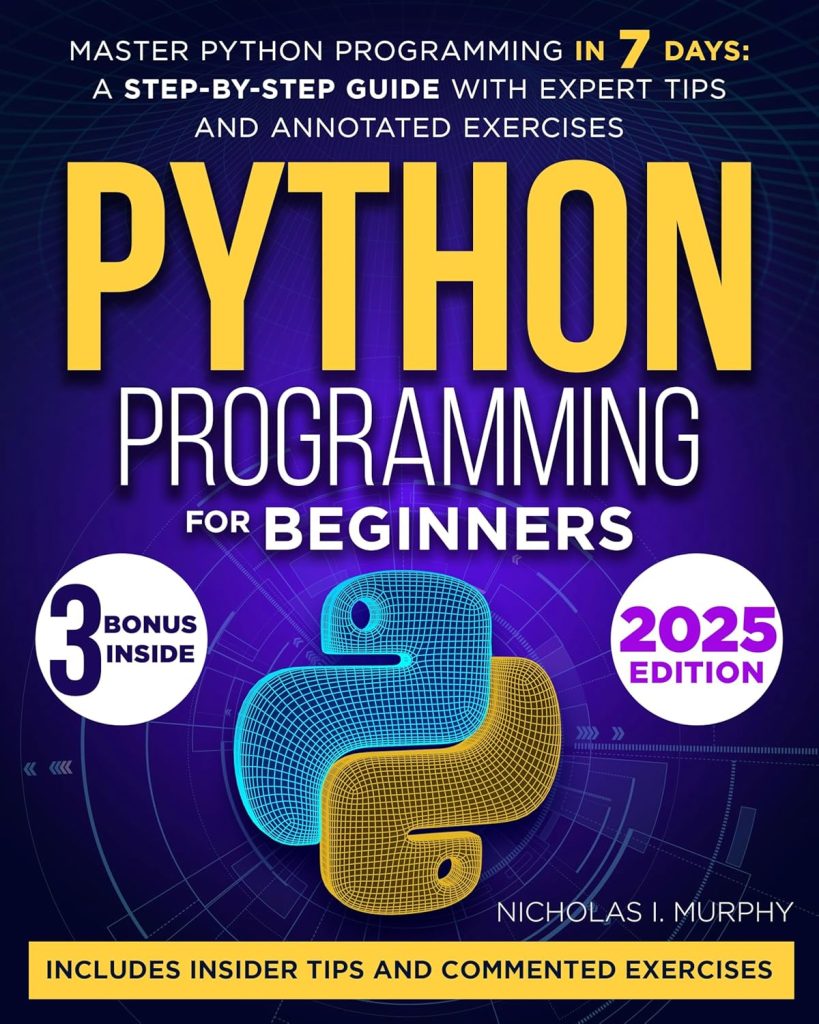

Overview of “The Python Programming: A Complete Beginners Guide To Python”
This Kindle edition is a comprehensive entry point tailored for newcomers to the Python programming language. It presents a structured approach to learning, aiming to provide all the essentials you need. As you dig into the contents, you’ll appreciate how well-organized the material is, making it easy to follow along.
Content Breakdown
This guide covers an array of vital topics that any aspiring Python developer should know. Let’s take a closer look at the aspects you’ll find most beneficial:
| Section | Description |
|---|---|
| Fundamentals | An introduction to Python, its syntax, and basic programming concepts. |
| IDEs | Information on Integrated Development Environments that can enhance your coding experience. |
| Data Types | A look at the various types of data you’ll work with in Python. |
| Advanced Structures | Delve into more complex structures that allow for organized data management. |
| Functions | Understanding how to create and use functions for better code efficiency. |
| Object-Oriented Programming | Learn about OOP concepts that form the backbone of many applications. |
| File Handling | Discover how to read from and write to files, an essential skill. |
| Exception Handling | Techniques for managing errors and debugging your code. |
| Bonus Exercises | Practical challenges to reinforce what you’ve learned. |
Fundamentals of Python
The fundamentals section serves as your introduction to the Python language. Here, you’ll find a clear explanation of what Python is, the philosophy behind it, and insights into why it has become one of the most popular programming languages in the world. The author does a wonderful job simplifying complex concepts, making the learning process less intimidating.
Integrated Development Environments (IDEs)
Using the right IDE can make programming not just easier but also more enjoyable. This guide covers popular IDEs like PyCharm and Visual Studio Code, discussing their features, benefits, and how to set them up. You’ll learn that the right tools can significantly improve your productivity and coding experience, helping you focus more on learning and less on technical hurdles.
Data Types in Python
Understanding data types is crucial when starting with any programming language, and Python is no exception. This section breaks down core data types such as integers, floats, strings, lists, tuples, and dictionaries. Each type is explained in detail, along with practical examples that show you how to utilize them effectively. You’ll gain a solid foundation, enabling you to manipulate and organize data efficiently.
Advanced Structures
Once you’ve mastered the basics, moving to advanced structures will be a natural next step. This guide introduces you to important concepts like sets and dictionaries, discussing the strengths and weaknesses of each. The explanations help you see when and why to choose a particular structure for your code, greatly enhancing your programming skills.
Functions: Your New Best Friend
Functions are a game changer in programming—they help you write cleaner, more efficient code. You’ll learn how to define your own functions, understand arguments and return values, and even explore lambda functions. Real-world examples throughout this section illustrate how functions can simplify tasks and make your coding more modular and readable.
Object-Oriented Programming (OOP)
The concept of Object-Oriented Programming can seem daunting, but this guide breaks it down into digestible parts. You’ll learn about classes, objects, inheritance, and encapsulation. The author provides examples that not only clarify theoretical concepts but also demonstrate how OOP can lead to better-organized code, making it easier to both develop and maintain.
File Handling
File handling is essential for many applications, and this section teaches you how to open, read, write, and manipulate files. You’ll learn about different file formats, how to handle files safely, and effective strategies for managing data. Understanding file handling is an invaluable skill, as it opens up numerous possibilities in programming projects.
Exception Handling
In programming, errors are inevitable, but how you handle them can set you apart. This guide introduces exception handling, discussing try, except, finally, and raise statements. With practical examples, you’ll gain the insights needed to address errors gracefully, ensuring robust and reliable programs. The author emphasizes the importance of writing code that anticipates potential issues.
Bonus Exercises
To reinforce your learning, the guide includes bonus exercises that challenge you to think critically and apply what you’ve learned. These exercises encourage hands-on practice, and going through them will solidify your understanding of key concepts. Working through these problems can also enhance your confidence as you move forward in your programming journey.

Pros and Cons of the Guide
Understanding what to expect from this guide can help you decide if it’s the right resource for you. Here’s a look at its strengths and some areas that might be less appealing.
| Pros | Cons |
|---|---|
| Comprehensive coverage of fundamentals and advanced topics | Some sections may be too concise for complete beginners |
| Clear explanations with practical examples | Occasional technical jargon without sufficient context |
| User-friendly organization that facilitates learning | Limited engagement; not interactive like a classroom setting |
Final Thoughts
This guide is a solid choice for anyone looking to embark on their Python programming journey. The balance of theory and practical examples prepares you well for real-world programming challenges. While there might be areas for improvement—like providing further context on some jargon—the overall clarity and structure make this a highly useful resource.
As you work your way through the chapters, you’ll appreciate how the author instills confidence, encouraging you to tackle challenges without fear. With practice and dedication, those complex programming tasks will soon feel like second nature. You’re not just learning Python; you’re building a solid foundation for future programming success.
Conclusion
By the end of this guide, you’ll possess a wealth of knowledge that empowers your coding journey. The content is well-crafted for beginners, enabling you to absorb complex information without feeling overwhelmed. The exercises and practical examples not only enhance your skills but also build your confidence in programming.
Investing time in this guide could very well be the step that transforms you from a curious beginner into a competent Python user, ready to tackle more intricate programming tasks in the future. Just remember to practice consistently, and you’ll find yourself not just learning Python but mastering it!

Disclosure: As an Amazon Associate, I earn from qualifying purchases.