
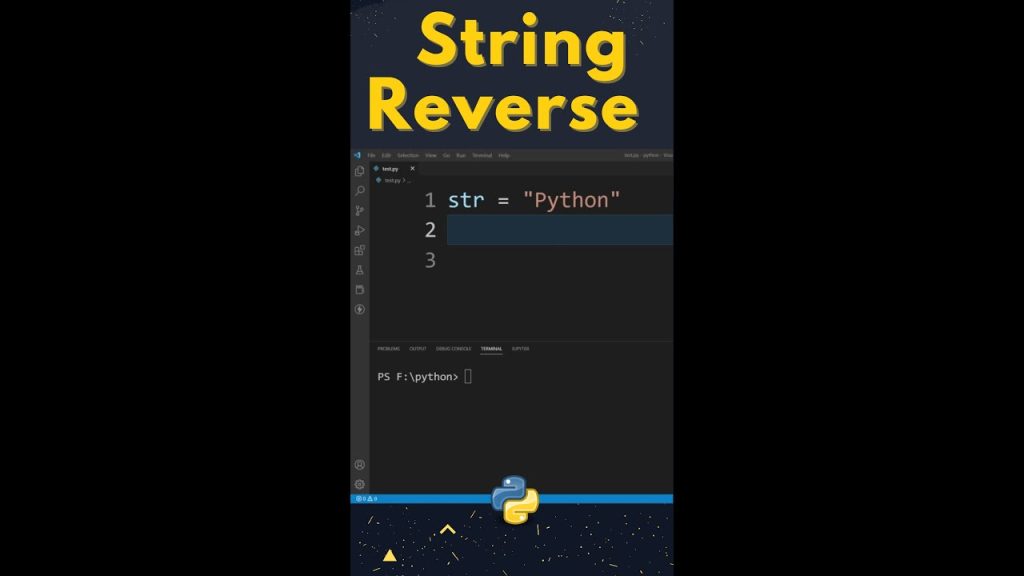
In this engaging piece, you’ll explore the simple yet effective method to reverse a string in Python using just one line of code. This handy tip is perfect for anyone looking to enhance their Python programming skills, whether you’re a beginner or preparing for an interview.
Alongside this valuable information, you’ll also find insights into related topics, including Python strings and coding interview questions that might come up for freshers. Embrace the opportunity to sharpen your coding technique and boost your confidence in tackling Python programming challenges effectively.
Understanding Strings in Python
Definition of strings
In Python, a string is a sequence of characters enclosed within single quotes ('...') or double quotes ("..."). Strings can represent text and are one of the most commonly used data types in programming. They allow you to handle and manipulate textual data effectively.
Characteristics of string data type
Strings in Python exhibit some unique characteristics. Firstly, they are immutable, which means once you create a string, you cannot change its content without creating a new string. Strings support indexing, enabling you to access individual characters, and they can be concatenated or repeated using the + and * operators respectively. Additionally, Python strings have a variety of built-in methods that allow you to perform operations such as transforming case, searching for substrings, and formatting.
Common operations on strings
Some common operations you can perform on strings include concatenation (joining strings together), slicing (extracting a part of the string), length checking (using len()), and searching for substrings (using methods like .find() or in). Understanding these basic operations is essential as they form the foundation for more complex string manipulations.
Importance of Reversing Strings
Use cases in programming
Reversing strings can be particularly useful in several programming scenarios, such as checking for palindromes (words that read the same backward as forward), data analysis, and even in string compression algorithms. It’s a fundamental operation that can enhance your ability to handle text data effectively.
Reversing strings in algorithms
In algorithm design, reversing strings often appears as part of more complex problems. For instance, during data parsing or during the manipulation of data structures such as stacks and queues, you may need to reverse the order of elements. Knowing how to reverse a string is a handy skill that can help you when working on algorithm challenges.
Practical applications in real-world coding scenarios
Real-world applications might include reversing user input for customized output, password encryption schemes, and data validation checks where the ordering of characters matters. The ability to reverse strings opens up various pathways for developing innovative solutions in your projects.
Basic Python Syntax
Understanding Python’s syntax
Python has a clean and easy-to-read syntax that makes it accessible for beginners. When working with strings, you’ll find that Python’s syntax allows you to perform operations seamlessly without complex formalities. This simplicity helps you focus on solving problems without getting lost in complicated code.
Overview of string manipulation methods
Python provides various built-in functions and methods to manipulate strings. Some of the most frequently used methods include .upper(), .lower(), .replace(), and .split(). Familiarizing yourself with these methods enhances your ability to handle strings effectively, making your coding more efficient.
Syntax structures relevant to string operations
While working with strings, you’ll often use syntax structures like loops, conditionals, and string interpolation. Understanding how these structures interact with string operations is essential to effective coding. This includes learning how to format strings using f-strings or the .format() method.
The Simple Method: Slicing
What is slicing in Python?
Slicing is a powerful feature in Python that allows you to extract a subset of a string using a specified range of indices. This can be particularly useful when you want to reverse a string, as it lets you manipulate sections of the string efficiently.
How to reverse strings using slicing
To reverse a string using slicing, you can utilize the syntax string[::-1]. Here, the first colon : indicates the start and end of the slice, while -1 indicates that you’re stepping through the string in reverse order.
Example: Reversing a string with slicing syntax
Here’s a quick example of reversing a string using slicing:
original_string = “Hello, World!” reversed_string = original_string[::-1] print(reversed_string) # Output: !dlroW ,olleH
This straightforward method is not only concise but also very efficient.

Using the Built-in Functions
Introduction to built-in functions
Python offers several built-in functions that allow you to perform common tasks without needing to write additional code. For reversing strings, these built-in functions can streamline your code’s readability and efficiency.
Using the reversed() function
The reversed() function returns an iterator that accesses the elements of the string in the reverse order. However, it does not return a string directly, so you’ll need to combine it with other functions to get the desired result.
Combining join() with reversed()
To convert the iterator back to a string, you can use the join() method. Here’s an example:
original_string = “Hello, World!” reversed_string = ”.join(reversed(original_string)) print(reversed_string) # Output: !dlroW ,olleH
This method is highly efficient and leverages Python’s powerful built-in capabilities.
Reversing Strings with Loops
Using for loops for manipulation
You can also reverse a string using a loop. By iterating through the original string and building a new string character by character, you can achieve the desired result. This approach provides more control over the string manipulation process.
Constructing a reversed string with a while loop
Another method is to use a while loop, where you gradually construct a new string by appending characters from the original one. For example:
original_string = “Hello, World!” reversed_string = “” index = len(original_string) – 1
while index >= 0: reversed_string += original_string[index] index -= 1
print(reversed_string) # Output: !dlroW ,olleH
This method showcases how loops can be utilized for string manipulation.
Performance considerations of loop methods
While loops provide a good learning experience, they may be less efficient than slicing, particularly for larger strings. This is due to the repeated string concatenation, which can lead to higher memory consumption and slower execution times.

Utilizing List Comprehensions
Understanding list comprehensions
List comprehensions offer a concise way to create lists and can significantly enhance the efficiency and readability of your code. You can leverage this feature to reverse strings with less overhead compared to traditional looping methods.
Reversing strings using list comprehensions
To reverse a string using list comprehensions, you can construct a new list that consists of the characters from the original string in reverse order, and then join them. Here’s how it’s done:
original_string = “Hello, World!” reversed_string = ”.join([original_string[i] for i in range(len(original_string) – 1, -1, -1)]) print(reversed_string) # Output: !dlroW ,olleH
This approach combines the power of list comprehensions with string manipulation effectively.
Advantages of list comprehensions over traditional methods
List comprehensions are often more efficient and concise compared to traditional methods like loops. They allow you to perform operations in a single line of code, making your programs cleaner and easier to understand.
Recursive Function for Reversing Strings
Defining recursion in Python
Recursion is a technique where a function calls itself to solve smaller instances of the same problem. In the case of reversing strings, you can define a recursive function to reverse the input string by breaking it down into smaller parts.
Step-by-step guide to creating a recursive reverse function
Here’s a simple recursive function to reverse a string:
def reverse_string(s): if len(s) == 0: return s else: return s[-1] + reverse_string(s[:-1])
original_string = “Hello, World!” reversed_string = reverse_string(original_string) print(reversed_string) # Output: !dlroW ,olleH
In this function, you take the last character and concatenate it with the result of reversing the remainder of the string, demonstrating the core principle of recursion.
Use cases for recursive string reversal
Recursive methods are often used in advanced algorithms and problem-solving scenarios. They can be beneficial for educational purposes, as they help demonstrate the concept of breaking down problems into smaller, more manageable parts.

Comparative Analysis of Methods
Efficiency of slicing vs loops
When it comes to performance, slicing is generally more efficient than loops for reversing strings due to less overhead in memory management. While both methods are effective, slicing tends to execute faster, especially for larger strings.
Readability of built-in functions vs custom methods
Built-in functions like reversed() and join() promote cleaner, more readable code when compared to custom methods involving loops or recursion. As best practice, you should consider prioritizing readability and maintainability in your code.
Choosing the best method for your needs
The best method for reversing strings largely depends on your specific requirements and coding style. If you need a quick, efficient solution, slicing is ideal. For more complex manipulations or when learning the fundamentals, loops or recursion can provide insightful experience.
Conclusion
Summary of string reversal methods
In summary, Python offers a variety of methods for reversing strings, including slicing, built-in functions, loops, list comprehensions, and recursion. Each method has its strengths and weaknesses, catering to different coding needs and preferences.
Final thoughts on choosing the right approach
When choosing a method for string reversal, consider factors like efficiency, readability, and how the method fits within the context of your overall coding project. It’s beneficial to be flexible and open to using different approaches as the situation demands.
Encouragement to practice with different methods
Keep experimenting with these techniques in your projects! By practicing string reversal in Python, you’ll enhance your coding skills and deepen your understanding of string manipulation. Happy coding!